
What do you do when cash flow comes under pressure at a mature, stable company? How quickly can you turn that around, and more importantly, how do you prevent it in the first place?
How a company manages cash flow differs sharply by life stage. In the life cycle of a business, we distinguish four phases: start-up, growth, maturity, and decline or transformation. Choosing and actively using the right KPIs for each phase turns cash flow management into a powerful steering tool rather than an administrative obligation. Today we look at the maturity phase.
The Maturity Phase: From Profit to Value
By the maturity phase, a company has thoroughly proven its right to exist. Revenue streams are relatively stable, processes are established, and customer relationships tend to be long-standing. The focus shifts from pursuing growth to optimising returns, strengthening competitive position, and creating lasting value for shareholders and other stakeholders.
Yet this very stability brings new risks. Where cash gets almost daily attention in the start-up and growth phases, mature organisations easily fall into the temptation of taking liquidity for granted. Focus shifts to revenue, margin, and profit, while the quality of cash flow is tracked less closely.
That means the essence of this phase, the shift from profit to value, is easily overlooked. A company can, after all, be profitable without actually creating value. Value only emerges when profit translates into healthy, predictable cash flows that can fund investment, innovation, debt reduction, dividends, or strategic acquisitions.
The Key Areas of Focus
Complacency and the erosion of financial discipline Successful organisations run the risk of paying less attention to cash flow simply because they have grown used to a healthy liquidity position. Investments get approved more quickly, overhead grows alongside the organisation, and the financial discipline that was second nature in earlier phases fades. Almost unnoticed, the question shifts from “Can we afford this?” to “Why wouldn’t we do this?“
Working capital that quietly seizes up A second area of focus is working capital. In mature organisations, inefficiencies tend to creep in gradually. Inventory levels rise, customer payment terms lengthen, and processes are managed less tightly. Each individual deviation may look minor, but the combined effect can be substantial. Large sums end up tied up in inventory and receivables, putting pressure on operating cash flow. The result: a profitable company needs increasingly more financing to support the same level of activity.
Effective capital allocation Mature companies often generate more cash than day-to-day operations require. That creates one of the defining management questions of this phase: how do you deploy available resources as effectively as possible? Is free cash flow used for growth investments, innovation, acquisitions, debt reduction, or dividends? Every choice affects future returns and the company’s value development. What sets strong companies apart is not the amount of cash available, but the quality of the decisions made with it.
Cash flow as a strategic steering tool Where cash flow management in the start-up and growth phases is mainly about continuity and financeability, in the maturity phase it is about value creation. That calls for an active, structured approach. Streamline processes to free up cash faster.
- Actively manage receivables, payables, and inventory.
- Use scenario analysis for investment decisions.
- Build financial buffers for economic headwinds.
- Make cash flow development part of strategic planning.
- Assess investments not only on profitability, but also on payback period and impact on free cash flow.
The central management question therefore changes fundamentally. Not: “Do we have enough cash?” But: “Are we creating maximum value with our cash?“
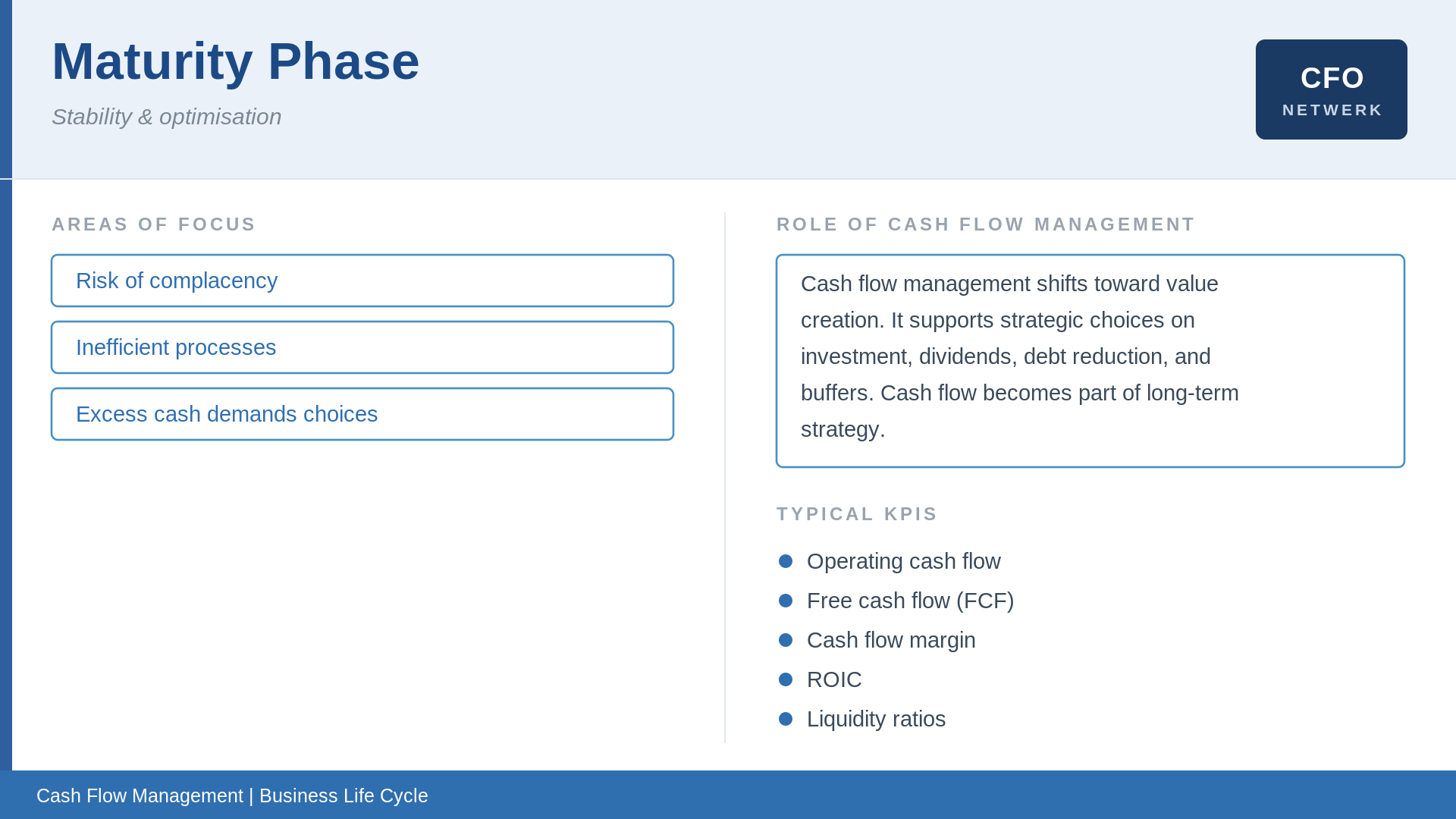
KPI’s That Provide Direction
To adjust course in time and deploy available resources optimally, the following KPIs are essential:
- Operating cash flow: Shows how much cash the company’s core activities generate.
- Free cash flow (FCF): Shows how much cash remains after investment in operations. This is the room available for dividends, debt repayment, acquisitions, and strategic investment.
- Cash flow margin: Operating cash flow divided by revenue. This ratio shows how much of every euro of revenue actually becomes available as cash.
- Return on Invested Capital (ROIC): Measures how effectively invested capital is used to generate returns and add value.
- Net debt / EBITDA: Shows the relationship between debt levels and the company’s operating earning power.
- Liquidity ratios (current ratio and quick ratio): Help assess whether the company can meet its short-term financial obligations.
Conclusion
Many companies associate cash flow problems with start-ups or fast-growing businesses. In practice, however, liquidity problems arise just as often in mature organisations, once financial discipline, working capital management, and capital allocation receive less attention. The best-performing companies therefore keep steering on cash flow, even when profitability looks healthy. They understand that profit is a result, but that value is created by how that profit is converted into available cash flow and then deployed.
The challenge in the maturity phase, then, is no longer to generate profit, but to convert that profit into value. Companies that succeed have the capacity to invest, seize opportunities, and absorb economic headwinds. And that is precisely what separates financially healthy companies from genuinely valuable ones.

